
NEW ZEALAND GREAT WALKS GUIDE

Abel Tasman Coast Track Guide: Everything You Need to Plan Your Hike

Abel Tasman National Park is a wilderness reserve at the top of the South Island boasting coastal forests, wildlife, and pristine white sand beaches. The Abel Tasman Coast Track is the easiest and most accessible of the Great Walks spanning 60 km. Abel Tasman is one of the most popular tracks with options to walk or kayak sections of the track and lots of opportunities to swim at beautiful beaches.


ABel
TASMAN
Each track has its own story - click the links below to find out what awaits you
Read our Abel Tasman Track experience
Want to know what it's really like? Read about our 4-day adventure, favourite viewpoints, hut stays, and the lessons we learned along the way.
abel tasman coast track quick overview
location
Situated at the top of the South Island. The closest city and airport is Nelson with Abel Tasman National Park approximately 1 hour's drive. This is a popular Great Walk so there are lots of transport options available.
difficulty
Abel Tasman Coast Track is the easiest and most accessible of the Great Walks. Great for first time multi-day hikers and families as you can shorten the days to suit all abilities. There are 4 huts and 18 camping sites along the track with water taxis servicing beaches.
at a glance
LENGTH: 60 km one way and can be hiked in either direction
DURATION: 3-5 days one way
DIFFICULTY: Easy to Moderate
CAMPING: Allowed with many campsites available to book
IMPORTANT: Tidal crossings are required at Torrent Bay and Awaroa Bay and must be planned around low tide. Bark Bay also has a tidal crossing, although an alternative all-tide track is available. The tides timetable can be located on the DOC website.
possible itinerary
Great Walks Season: All year round
DAY 1: Marahau to Anchorage (4hrs / 12.4km)
DAY 2: Anchorage to Awaroa (7.5hrs / 21.9km)
DAY 3: Awaroa to Whariwharangi Bay (5hrs 30mins / 16.9km)
DAY 4: Whariwharangi Bay to Wainui car park (2hrs / 5.7km)
WHY WALK THE ABEL TASMAN COAST TRACK
BEST FOR: First-time Great Walk hikers, families, beach lovers, flexible itineraries and warmer-weather hiking.
The Abel Tasman Coast Track is unlike any of New Zealand's other Great Walks. Instead of mountain passes and alpine scenery, you'll spend your days walking through native forest, crossing tidal estuaries, and relaxing on some of the most beautiful beaches in the country. The national park is also home to New Zealand fur seals, native birds, little blue penguins, and, if you're lucky, dolphins or even orca in the bays.
What really sets the Abel Tasman apart is its flexibility. Thanks to the network of water taxis operating throughout the park, you don't need to commit to the full track. Whether you have a few hours, a single day, or several days to spare, it's easy to create an itinerary that suits your fitness level, schedule, and budget.
Compared with the Routeburn, Kepler and Milford Tracks, the Abel Tasman is less physically demanding but offers New Zealand's best coastal walking experience.
Choose the Abel Tasman Track if:
-
You don't have time for a full multi-day Great Walk. Water taxis can access multiple points along the track, making it easy to walk only the sections that interest you most.
-
This is your first multi-day hike or you're hiking with children. The track is one of the easiest Great Walks, with relatively gentle gradients and plenty of hut and campsite options to break up the journey.
-
You would like some flexibility with your itinerary. Distances can be shortened using water taxis, and there are more hut/campsite choices than most Great Walks.
-
You enjoy swimming. Many of the beaches along the track are perfect for a refreshing dip at the end of the day.
-
You miss out on DOC hut bookings. In addition to DOC campsites, the track also offers alternative accommodation options including Awaroa Lodge.
-
You're interested in spotting wildlife. Seals are commonly seen along the coast, while dolphins, penguins, and occasionally orca can also be found in the park.
-
You like the idea of combining hiking and kayaking. Several operators offer kayak trips that allow you to paddle sections of the coastline before continuing on foot.
The Abel Tasman Track may not be for you if:
-
You're looking for dramatic mountain scenery, alpine passes, or a remote backcountry experience.
-
You want a physically demanding hike. While there are still a few climbs, the Abel Tasman is generally regarded as the easiest of New Zealand's Great Walks.
-
You prefer quieter tracks. The Abel Tasman is the most visited Great Walk and popular sections can feel busy, especially during summer when day walkers, kayakers, and guided tours share the track.
abel tasman coast track overview
The Abel Tasman Coast Track follows beautiful coastline through forests and across white sandy beaches. It is one of the most popular Great Walks along with the Milford Track and Routeburn Track and is the most accessible of all the Great Walks. The track can be accessed by water taxi into many of the beaches giving hikers the option to walk sections of the track or use luggage transfer services. The National Park is popular for water activities and hikers can also opt to kayak sections of this Great Walk.
The Abel Tasman track is 60km in length and can be completed in 3 to 5 days one way. It is not a loop track, and transport will need to be arranged. You can walk the track in either direction, starting from Marahau (1.5hr drive from Nelson) or Wainui Car Park (2hrs drive from Nelson) depending on which direction you choose to hike in. There are 4 huts on the track - Anchorage Hut (34 bunks), Bark Bay Hut (34 bunks), Awaroa Hut (26 bunks), and Whariwharangi Bay Hut (20 bunks). There are also 18 campsites located along the track which must also be booked in advance.
The Abel Tasman track is a great track for hikers new to multi-day hiking and families with little hikers as it has wide and well-maintained pathways. The track can easily be tailored to suit your preferred walking distances and timeframe. Day walks can easily be arranged and are popular on this track. Alternatively, if you are unsuccessful securing huts or campsites, it's possible catch water taxis in and out of the track to accommodation.
BEST TIME TO WALK THE ABEL TASMAN COAST TRACK
The Abel Tasman Coast Track can be hiked year-round, much like the Lake Waikaremoana Track, Heaphy Track, Paparoa Track, and Rakiura Track. If you are keen to swim, then summer between December - March is an ideal time to experience the track. The temperatures are warmer and the ocean will be more pleasant to swim in. The weather tends to be more settled particularly from January to March in New Zealand but these will also be the busiest months on the track.
If you are keen to swim, summer between December and March is an ideal time to experience the track. Temperatures are warmer, and the ocean is generally more pleasant for swimming. The weather also tends to be more settled, particularly from January to March in New Zealand. However, these are also the busiest months on the track.
If you are looking for a quieter hike with fewer people, or if you have missed out on summer bookings, the autumn and spring shoulder seasons are a great time to walk the track.
The Abel Tasman Coast Track can absolutely be hiked in winter, but water taxi services are often reduced from 1 May to 30 September. Make sure you book transport in advance and double-check pick-up times to ensure you can reach your pick-up points as planned. Allow extra flexibility in your itinerary, particularly if weather conditions affect operations. The good news is that water taxis continue to operate seven days a week throughout winter.

WHAT TO EXPECT ON THE ABEL TASMAN TRACK
From Marahau To Wainui (4 day walk)
Day 1 - Marahau to Anchorage Hut - 12.4 km / 4 hrs
Day 1 starts at Marahau with a 12.4 km hike to Anchorage Hut/Campsite taking approx. 4 hrs. It is possible to push on to Bark Bay Hut instead which will take approx. 8 hrs to complete the 23.9 km. Hikers cross the first estuary to enter the track and the paths are wide and firm. The track provides glimpses of the water through the trees and any upward gradient is relaxed. Apple Tree Bay is a good halfway point for lunch and a swim. The track then passes through several little gullies before opening up with spectacular views of Torrent Bay and the track to the north. The track descends into Anchorage Bay and the hut sits beachfront.
There is a 40 min return side trip to Cleopatra's pool which is a majestic swimming hole. Consider completing this side trip on Day 1 as Day 2 is a long day.
Day 2 - Anchorage Hut to Awaroa Hut/Campsite - 21.9 km /7 hrs 30 mins
The 21.9km hike from Anchorage Hut/Campsite to Awaroa Hut/Campsite is the longest day and will take approx 7hrs 30mins to complete. From the end of Anchorage Bay hikers will cross Torrent Bay estuary. The estuary can only be crossed 2hrs either side of low tide and hikers can expect to get wet. After the estuary, the track climbs into forest and around two valleys. Bark Bay Hut is reached after 11.5 km and is a good mid-way point for lunch.
Hikers then cross Bark Bay estuary which can be crossed 2 hrs either side of low tide but there is a 10 min alternative all-tide track if needed. The track climbs steeply into forest again until returning to the coast at Tonga Bay and the beautiful Onetahuti Bay. Hikers cross Onetahuti beach, navigate a boardwalk section, and then gradually climb up Tonga Saddle. Eventually you will come to a junction where a sign points towards Awaroa Lodge. A winding path then leads down to the lodge. By continuing straight ahead you will reach the lookout point over Awaroa Bay and then drop into Awaroa Hut/Campsite.
If you have time (or stayed at Bark Bay hut on Day 1) there is a 1 hr 30 min return side trip from Torrent Bay to Cascade Falls, a lovely hidden waterfall in bush.
Day 3 - Awaroa Hut/Campsite to Whariwharangi Hut/Campsite - 16.9k m / 5 hrs 30 mins
The 16.9 km hike from Awaroa Hut/Campsite to Whariwharangi Hut/Campsite will take approx. 5 hrs 30 mins. The day begins with the Awaroa Inlet crossing, which should only be attempted during daylight hours and within 1 hr 30 mins before and 2 hrs after low tide. There is no alternative track so hikers will need to time the low tide here.
The track then meanders through forest as you pass Waiharakeke Bay and then Goat Bay where hikers will need to cross the beach. There is a steep ascent to Skinners point with great views before descending down onto Totaranui Beach. This is the furthest beach the water taxis will pick up from and a great stop for lunch.
From here hikers will cross or go around Totaranui estuary and climb steeply into lush forest towards Anapai Bay and then Mutton Cove. There is one last saddle to climb before descending to Whariwharangi Hut/Campsite. Hikers can opt to take an alternative track via Separation Point, which will add an extra hour of walking time.
Day 4 - Whariwharangi Hut/Campsite to Wainui car park - 5.7 km / 2 hrs
The final day is short and easy and will take approx. 2 hours. From the hut, the track follows a small stream and climbs up the saddle to get views over Wainui Inlet. From the saddle it's a quick descent to the car park.
At the top of the saddle there is an alternative inland track over Gibbs Hill that will take hikers back to Totaranui to catch the water taxi out of the Abel Tasman Park. This 9 km alternative route will take approx. 3hrs to complete. However, if you don't mind back tracking, you can return via the coast.

ABEL TASMAN DAY Walk Options
The Abel Tasman Coast Track is the most accessible of the Great Walks with water taxis servicing the main beaches from Marahau or Kaiteriteri, going as far north as Totaranui Beach. Check out the walking times between each beach to create a hike that suits. Don't forget, estuaries at Torrent Bay and Awaroa Bay need to be crossed within a couple of hours of low tide so check the tide timetable when planning and deciding on what dates to hike.
The easiest day walk is from Marahau to Anchorage Bay. The hike is approx. 4 hours / 12km one-way andd can easily be completed as a return trip in one day. Anchorage Bay has a lovely beach to hang out at for the day and swim. Water taxi's service this beach to take you back to Marahau if you prefer to walk one-way.
If you are looking for a quieter experience, catch a return water taxi to Totaranui Beach and hike north to the stunning Mutton Cove. This beautiful walk is approximately 6 km one way and takes around 3 hours. Many hikers finish their Abel Tasman adventure at Totaranui, as this is as far as the water taxis travel. This means that far fewer people venture further north. In our opinion, some of the most beautiful beaches in the entire park are found on this section of track, and there's a good chance you'll have them almost all to yourself.
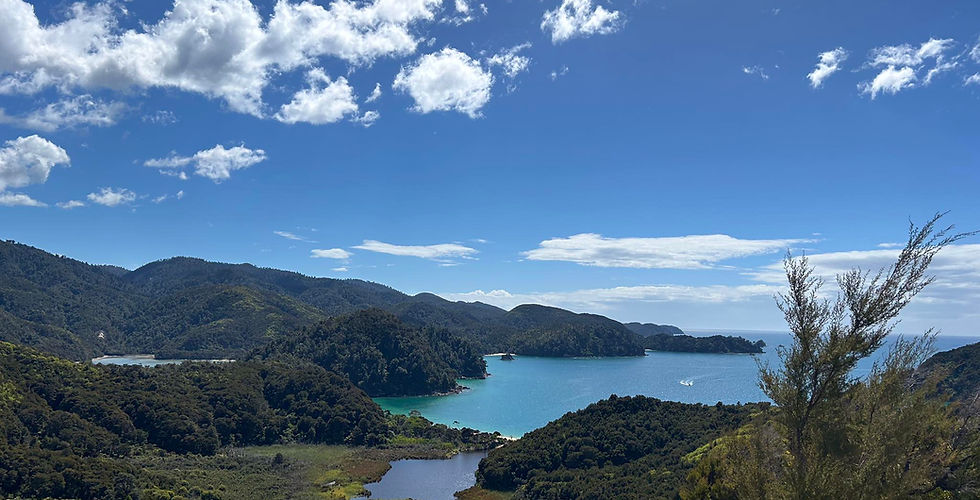
ABEL TASMAN DIFFICULTY
The Abel Tasman Coast Track is considered the easiest of all the Great Walks. The track is flat, wide and well-maintained without a lot of tripping hazards. Many people had told us prior to this walk that it was 'flat'. It's not, anyone who says this usually has not completed the full Great Walk. The track follows the coastline and goes in and out of bays requiring ascents, some of them steep, and then descents back down into the bays. You will cross a few beaches which can be hard work with a full pack in the soft sand. But we agree it is the easiest of the Great Walks and also the most relaxing with the ability to stop, swim and laze around on the beach as you progress.
Abel Tasman Track Elevation Profile
ABEL TASMAN TRACK LOGISTICS & BOOKINGS
The Abel Tasman Coast Track is a popular Great Walk, and it can be difficult to secure hut/campsite spots. Some campsites sell out in minutes particularly for holiday periods, particularly Totaranui Campsite as there is road access. Besides the Heaphy Track, this was one of the more difficult Great Walks to plan logistically as the ocean tides need to be considered before selecting dates.
TIDAL TIMETABLE
Before finalising your itinerary, be sure to check the low tide timetable, which you can find here. Estuary crossings at Torrent Bay and Awaroa Bay are an important part of planning your Abel Tasman hike, as they can only be crossed safely from 1.5 hours - 2 hours before and after low tide.
Several other estuary crossings are found along the track, but these have alternative high tide routes available. Keep in mind that these detours can add extra time and distance to your day.
If you miss the low tide window at Torrent Bay or Awaroa Bay, the estuaries should not be crossed. This means you may need to choose specific hiking dates and carefully plan your overnight stops to ensure you reach these crossings at an appropriate time of day. Estuaries should never be crossed at night.
Fortunately, there are plenty of hut and campsite options along the track, making it easier to plan your itinerary around the low tide times.
Before you book anything, secure bookings for the huts/campsites first. For more information on Department of Conservation (DOC) huts/campsites check out the PLAN & BOOK section above or click the link below.
The Abel Tasman Coast Track is popular with tourists and as such there are plenty of transport options available to get you to and from the track including buses, shuttles, and water taxis. Check out the BOOK IT section or click the link below for more information.

Things We Learned
1. The Abel Tasman track is undulating and not flat. There are some steep climbs that will get your heart rate pumping.
2. It can get cold even in summer. Once we reached Whariwharangi Hut the temperature dropped quickly, and we lit the fire to warm the hut (and us) up.
3. Put your gear incl your sleeping bag in dry bags inside your pack. A couple of the crew had to re-learn this when the bottom of their packs got wet on the Awaroa Inlet crossing. Lucky for them the fire at Whariwharangi Hut cranks and the bags were bone dry by bedtime. Lucky buggers.
4. Trail shoes were totally fine to walk in. Consider the weather though before deciding on your footwear.
5. Crocs were great for the estuary crossing (and in general life).
6. Awaroa Lodge and the staff were awesome. If the weather permits Awaroa Lodge opens a pizza and beer garden, the quick detour for a cold one is worth it. You will see the turn off to head down to the lodge. Don't worry, you don't have to climb back up to get to Awaroa Hut. Continue walking past the airstrip to the beach and Awaroa Hut is not much further along.
TIPS From The Crew
1. Before you book, consider the low tides on the days you intend to hike. You will need to make some water crossings and need to do so a couple of hours either side of low tide in daylight to make it. This may mean that you may have to hike on particular dates.
2. Anchorage Hut is on a stunning beach and is a great hut. Totally recommend staying here. There is a simple cold outdoor shower on Anchorage Beach a few meters down from the hut.
3. Take some Crocs or aqua shoes for the tidal crossings (not flip flops/jandals these will get stuck). There are shells and stones that can cut your feet in the estuaries.
4. Follow the tallest person into the water crossings first so all the short people can see how high the water comes up on them. Don't cross outside of the recommended timeframes otherwise you will be swimming and with a pack can be dangerous.
5. Awaroa Lodge has a pizza and beer garden during the day (weather permitting). Drop in on the way to Awaroa Hut or stay the night at the lodge. The staff and the packed lunches were awesome.
6. Best Beach - Mutton Cove without a doubt. Many hikers stop at Totaranui and won't hike as far, so the track becomes less populated. If you are camping this is an awesome bay to stay for the night.
7. We backtracked from Whariwharangi Hut to Totaranui and caught the water taxi out (rather than hike 2hrs out to Wainui Bay). There is an inland track via Gibbs Hill you could take instead to Totaranui but we preferred to swim, so returned via the coast. The water taxi was a nice way to finish and took us past Tonga Island to see the seal colony which was pretty cool.
abel tasman track common questions
What is the best direction to walk the Abel Tasman Coast Track?
Either direction is fine, but the Marahau to Wainui direction gives more transport and accommodation options. Water taxis and buses typically leave from Kaiteriteri and Marahau into the Abel Tasman National Park. Wainui is more remote and hikers will need to organise a 1.5-hour shuttle at the end of their hike to return to Wainui as water taxi's only go as afr north as Totaranui.
Can you walk the Abel Tasman Coast Track in 3 days?
Absolutely, for fit and experienced hikers this is very achievable. Even though the days will be long at 20+ kilometers per day the track is not very technical, easy to navigate, and easy to hike at a good pace. The challenge will be ensuring that you can reach Torrent Bay and Awaroa Bay estuaries within 2 hours to 1.5 hours before or after low tide to safely cross. Check the tide timetable and consider which huts and campsites are best to book for your itinerary.
Typically, hikers will complete the Abel Tasman Track in 4 days and 3 nights.
Do I need to book water taxi's in advance?
During the busy summer period it is easy enough to book water taxi's on the day or the day before. Hikers can also approach the water taxi's and ask if there is space. However, if you are need particular pick-up times it is best to book these in advance. We suggest booking transport as soon as the huts/campsites are booked.
During 1st May to 30th Sept, water taxi's are greatly reduced and may require minimum booking numbers to proceed. It is recommended to book transport well in advance during this time.
Can I leave my car at Marahau or Wainui car parks?
Yes. Department of Conservation (DOC) provides a car park at both ends of the track, with Wainui Car park being typically more remote. Cars are parked at your own risk, and although less common break0ins can occur. There are more secure car parks available or other transport options if you would prefer not to leave your car unattended.
Is Abel Tasman Coast Track suitable for beginners?
Yes. The Able Tasman Track is considered one of the easiest Great Walks as the track is wide, easy to navigate and the terrain is not technical. As the track is accessible by water taxi and there are plenty of hut/campsite options, hikers can plan an itinerary to suit their abilities.
Can children walk the Abel Tasman Coast Track?
Yes. The Abel Tasman Track is a great beginner track to introduce children to multi-day hiking. The track is free from tripping hazards and is wide and easy to navigate. Consider the abilities of your children and plan your itinerary for suitable walking times and distances. Water Taxis also offer pack drop services to enable children (or their parents) to carry less gear.,
Is the Abel Tasman Track flat?
No, sorry. There are definite hills to climb but they are not as difficult or as strenuous as the alpine Great Walks. Hikers can expect to navigate hills when climbing in and out of each beach.
Do you need hiking boots for the Abel Tasman Track?
Depends, but generally no. The track is not technical or rocky, and many hikers will walk in trainers. However, consider the time of year and forecasted weather before choosing footwear. In the drier, summer months, trainers are absolutely fine, but hikers may prefer boots if wet/muddy conditions are expected. If you are carrying a heavier pack, consider hiking shoes instead that have a stiffer sole to absorb the weight of the pack. Your ankles will thank you for it.
Can you buy food on the Abel Tasman Track?
Awaroa Lodge offers meals at the restaurant and have a pizza and beer garden in summer on fine weather days. Awaroa Lodge also offers packed lunches for hikers that stay the night for the next day's adventure. Otherwise, hikers must carry all food in and all rubbish out of the track.
Is there drinking water on the Abel Tasman Track?
Yes, drinking water is available at huts and most campsites along the track however must be treated or filtered prior to consuming.
Are there toilets on the Abel Tasman Track?
Yes, there are either flushing toilets or pit toilets at the huts and campsites. Don't forget to pack plenty of toilet paper.
Can you swim at the beaches?
Definitely, yes. The beaches on the Abel Tasman are gorgeous golden sandy beaches and are generally pretty safe. Do take normal water safety precautions and stay clear of any wildlife.
Can you charge your phone at the huts?
No. DOC huts on the Abel Tasman Coast Track have limited power, and hikers should not expect to be able to charge electronic devices. Bring a fully charged phone and a portable power bank if you plan to use your phone for photos, navigation, or checking tide times.
Is there phone reception on the Abel Tasman Track?
There is limited phone reception on the track. Don't rely on reception or download the Abel Tasman App which has information on weather, tides, points of interest, history, and plants. It has geo-location and will work offline.


